DUI Records in Sedgwick County are accessible through the county’s online portal, letting users quickly locate case numbers, arrest dates, and court outcomes. A Sedgwick CountyDUI record search returns arrest information, charge details, and sentencing notes, while the Sedgwick CountyDUI case lookup feature links to hearing logs and probation orders. The system pulls data from criminal records, traffic records, and court filings, ensuring you see the full case history in one place.
Looking for a certified copy of a DUI court record? A Sedgwick CountyDUI record request can be submitted at the courthouse or via the official website, and the staff will confirm fees and processing time. You can verify case status, judgment, and any license revocation or ignition interlock order. For missing files, the district clerk matches names to case numbers and resolves unlisted entries promptly.
How to Search DUI Records
DUI records are court and agency records tied to a driving-under-the-influence arrest, charge, or case. A search can help locate the case number, party name, charge, docket entries, orders, and disposition, allowing readers to tell an arrest apart from a conviction and find the correct court file. Residents can also inspect busted mugshots for detailed public documentation. The main purpose is verified case retrieval rather than a general driving-record check. Availability varies by court, record type, and legal status.
Official Search Portal: https://www.dc18.org/records
Steps to Search
- Open the District Clerk’s records portal and choose the criminal case search area offered on the page.
- Enter the case number when known. If the number is unknown, use the party’s exact legal name and any date or case-type filters shown.
- Compare each result by case number, party name, charge, court, and filing or arrest date. A similar name may belong to a different person.
- Open the matching case and review its docket entries for the charge, hearings, plea, trial, court orders, and case disposition.
- Follow the portal’s instructions for an ordinary or certified copy. For an unmatched file, use the District Clerk contact details at the end of this page.
Choosing the Correct Case
Sedgwick County DUI records may come from several sources. A criminal case filed in Sedgwick County District Court belongs in the District Clerk’s portal. A city-ordinance traffic matter may belong to a municipal court, such as Wichita Municipal Court, and a driver-license action is maintained by the Kansas Department of Revenue. A police incident report is also separate from the court docket. The court named on a search result determines where the correct case file should be found.
Most DUI prosecutions under Kansas law are filed in district court. The charge may cite K.S.A. 8-1567 for driving under the influence or K.S.A. 8-1567a for a related test-refusal offense. A citation, complaint, or arrest shows that the person faced a charge. It does not prove that the person was convicted.
Identifiers That Reduce Search Errors
A case number is the most precise way to find a known court file. A name search can return multiple cases, including cases involving relatives or people with similar names. The party’s full legal name, including any suffix shown on the court record, gives the best starting point when no case number is known. Arrest date, court, and charge type help confirm that the result matches the intended case, but none should replace the case number once it has been found.
Keep the case number with any requested copies. It saves staff time, reduces the chance of selecting a similar case, and makes it easier to compare an online docket entry with a paper order. If several results share the same name, open each result and compare the court, charge, and date before choosing a document.
Case Proceedings, Penalties & Licensing
A DUI case can contain several different records: police reports, criminal charges, hearing entries, plea records, trial results, sentencing orders, probation terms, and driver-license actions. Each entry answers a different question. A complete review keeps those records separate and shows how the case moved from arrest through disposition.
Arrest Logs, Offense Charges & Court Orders
A police record may show the arrest date, arresting agency, officer’s report, citation, and alleged offense. The court record usually begins with the filing that assigns a case number. It can then contain the complaint or information, bond, arraignment, discovery motions, hearing settings, continuance orders, witness preparation, and other pretrial actions. Exact entries depend on the facts and the path taken through the case.
The charge caption identifies the statute cited by the prosecutor. For a Kansas DUI matter, common legal references include K.S.A. 8-1567 and K.S.A. 8-1567a. The court file may also include a separate complaint for a related offense, such as driving without a valid license, if that charge was filed in the same case. A person can have charges arising from one stop even when each charge follows a different legal path.
Court orders document decisions made by a judge. An order can address bail, suppression of evidence, discovery, a continuance, a plea agreement, sentencing, probation, or a restricted driving privilege. The order itself provides the court’s action on that request. It does not necessarily resolve every other charge listed in the same case, so readers should check the disposition and sentencing entries for the full outcome.
Pleas, Trials, Convictions & Dismissals
A docket can show a plea of guilty, no contest, or not guilty. A guilty or no-contest plea can lead to a conviction and sentence. A not-guilty plea usually sends the case toward trial unless the parties resolve it earlier. The plea entry should be compared with the sentencing or disposition entry because the docket may use different labels for each stage.
Trial records may identify a jury setting, bench trial, witness list, jury instructions, verdict, or dismissal. A guilty verdict leads into sentencing. A not-guilty verdict is an acquittal, meaning the court did not find the defendant guilty of the charged offense. A dismissal ends the case without a conviction on the dismissed charge, although the order can state whether the dismissal followed a plea agreement, a motion, or a decision made during trial.
The clearest result comes from reading the case entries as a sequence. A charge alone does not show guilt, and a plea alone does not explain the sentence. The disposition, judgment, and probation entries establish what the court ordered after the plea or trial. Readers searching for a conviction should check for both an adjudication entry and the sentence that followed it.
Fines, Probation & Deferred Dispositions
A DUI sentence can include a fine, court costs, incarceration, probation, driver-license consequences, and other terms. The exact penalty depends on the charge, the defendant’s record, the license class, and the sentencing order. A general statement about DUI penalties may not match the sentence entered in a particular Sedgwick County case.
A probation record can list the length of supervision, reporting duties, payment terms, treatment or education requirements, and other conditions. Later entries may record modifications, alleged violations, revocation, or completion. Completion of probation does not erase the conviction. It shows that the court acted on the probation status, and the disposition or release entry should be read for the exact wording.
A deferred disposition is not the same as a dismissal or acquittal. Kansas uses deferred prosecution and diversion provisions under K.S.A. 22-3301 and K.S.A. 22-3302. An agreement can require compliance with court-approved terms before the court reaches the ending stated in the order. Until that ending is entered, the online docket may show a pending, deferred, or agreement status instead of a completed disposition.
Deferred and diversion records deserve careful review because the same label may appear on different parts of a docket. One entry can announce the agreement, another can set a review date, and a later entry can record the outcome. Search for the case closure or sentencing entry to determine how the deferred matter concluded.
Suspension, Revocation & Ignition Interlock Orders
Driving-privilege consequences can appear in the criminal file or in a separate driver record. Possible actions include an administrative suspension or revocation, a court-ordered suspension, a license restriction, or an ignition interlock requirement. The responsible agency and the type of conviction can affect which action applies.
The court file is the primary source for a judge’s licensing order. The Kansas Department of Revenue maintains the official driver record and current license actions. A closed criminal case does not by itself prove that a license restriction has ended or that a later administrative action is inactive. Current driving status should be checked against the state driver record and the court order that created it.
When an ignition interlock is ordered, the file may identify installation, reporting, or compliance duties. An interlock entry does not prove that a device is currently installed or working. The docket can show what the court required, but present compliance may involve later reports, payments, or agency records. Read the order’s dates and conditions before drawing that conclusion.
How the Court File Differs from Other DUI Records
The four sources below answer separate questions. Reading them together gives a fuller picture of the arrest, prosecution, sentence, and license history without treating one record as a substitute for another.
Public Availability & Official Copies
Many Sedgwick County court entries can be viewed through official channels, but availability depends on the agency that holds the record and the legal status of the file. A District Court case, a police incident report, and a Kansas driver record follow different request paths. Public access to one source does not create public access to every related document.
Court and Police Record Sources
The District Clerk’s portal provides an official index for records filed in Sedgwick County District Court. A search result can help identify the case number and court docket. You can also access arrest bureau to review official records. Some results may provide a document image or a request function, while other entries may show only the docket text. A search result is a case index, not an automatic certified copy.
Police incident reports are maintained by the agency that created them. A police report can contain details that do not appear in a court docket, including officer narratives, evidence notes, and investigative records. If the needed document is a police report rather than a court filing, the request belongs with the police agency that holds it. The District Clerk cannot release records that the clerk’s office does not hold.
Sedgwick County criminal records, traffic records, and driving records can refer to different collections. A criminal court docket shows what happened in a filed case. A municipal traffic file belongs to the court named on that citation. A driving record shows state license actions rather than the full court narrative. The title of a result should be checked before a document request is made.
Sealed, Expunged & Confidential Exclusions
Public court records still have legal exceptions. Kansas Open Records Act provisions, including K.S.A. 84-512 and related sections, apply public-record rules. Court orders, statutory protections, and judicial rules can also limit access to a particular file or document. A missing search result may reflect one of those protections rather than the absence of a DUI case.
A sealed file has been closed to public viewing by a court order or legal rule. A confidential file is protected under a statute, court rule, or order. The two labels can describe different legal restrictions. The District Clerk can explain the status shown by the file and the process that governs it. Any request to remove a seal must follow the applicable court procedure rather than a records-portal request.
Expungement is a separate legal status governed by K.S.A. 22-3201. A DUI conviction does not automatically qualify for expungement. The offense classification, prior record, completion of the sentence, waiting period, and other statutory bars can affect eligibility. An expungement order may remove an entry from the public case index or restrict public viewing. Absence from a public search by itself does not prove that a record was expunged.
Juvenile matters have separate access rules. A youthful offender file should not be treated like an adult criminal file, and a juvenile label on another agency’s record does not make the entire related file open. Readers who need a sealed, expunged, confidential, or juvenile record should state the exact document and legal purpose when seeking guidance from the District Clerk.
Online & District Clerk Requests
The fastest path for a known court document begins with the portal search and the case number. A portal request function may provide document retrieval and payment. When the requested document or certification is not offered online, the request can be handled through the District Clerk’s courthouse office. The exact request route shown by the clerk should be followed for the selected copy type.
Request Workflow
Prepare the case number, the exact party name, the court, and a clear description of the needed entry. A document date or docket-entry date can help the clerk identify the right page. If the request concerns a police report, name the police agency and describe the report instead of referring only to the criminal case number.
Check the case result before placing an order. A missing document image does not always mean the docket entry is absent, and a visible image does not create a certified copy. Current identification, payment, delivery, and request instructions should be confirmed with the District Clerk before sending payment or personal documents.
Certified Copies, Fees & Fulfillment Timelines
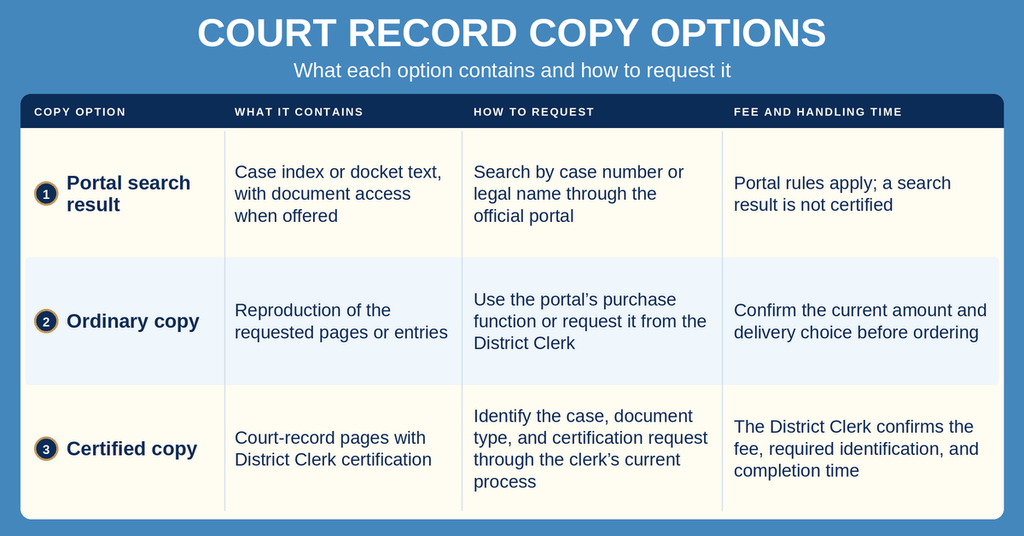
A certified copy carries the District Clerk’s certification that it reproduces the court record. An ordinary copy provides the requested pages without that certification. Courts, employers, licensing agencies, and other recipients may ask for a certified copy or accept an ordinary copy, so the requesting organization’s rules should be checked before ordering.
The District Clerk must confirm the current fee, accepted payment method, identification requirements, delivery choice, and handling time for each request. A portal result does not promise a fixed fee or same-day certification. The amount can differ by copy type and the number of pages requested, and current clerk policy controls any charge. Old fee amounts from private websites or earlier cases may no longer be correct.
Ask for a completion date when placing a large or certified request. Keep the receipt, case number, document description, and delivery record. If a document arrives with the wrong case, missing pages, or a different name, contact the District Clerk with those details. A correction request for an inaccurate docket entry is separate from a request for a new certified copy.
Record Accuracy & Resolution
A search result can require follow-up. A missing entry may reflect a name mismatch, a filing that has not reached the index, a case in another court, or a legal exclusion. An entry that looks wrong should be compared with the case number, docket sequence, and court order. The goal is to identify which source contains the controlling record.
Matching Person Names & Case Numbers
Name searches depend on the legal name stored by the court. Middle names, suffixes, and spelling differences can affect the results. If the first search produces many cases, use the party’s exact legal name and narrow the list by court, charge, or date when those filters are offered. Comparing several fields reduces the chance of selecting a relative or another person with the same name.
Once a case number is known, check every digit against the docket and requested document. A copied or transcribed number can point to another case, particularly when the number is long. Arrest date is a useful cross-check because the court filing date may differ from the arrest date. A charge abbreviation can also vary by court, so the full case entry is better than a label alone.
System Delays Between Police & Courts
A police report, prosecutor charging decision, clerk filing, hearing entry, and sentencing record are created at different stages. A recent arrest may not yet have a court case number. A clerk entry can also appear after a hearing or sentence has occurred. Short gaps between systems do not by themselves show that a record was lost.
The online index and the physical court file can have different update points. If a recent event is missing, first check the date of the most recent docket entry and compare it with the event in question. A records request based on the correct case number can then ask the clerk to check the file rather than treating the search page as a complete account of every event.
Unlisted DUI File Resolution
When no result appears, search again with the case number, then with the exact legal name. Confirm that the correct court and county were selected. If the matter involved a city traffic ordinance, check the municipal court named on the citation instead of assuming it belongs in the District Court portal. A pending case can remain outside public view for a period, and a sealed or expunged file may never appear under its former case number.
For help with a possible mismatch, give the District Clerk every known identifier: exact name, case number, arrest date, court, charge, and any police agency reference. Keep each item labeled so staff can match it against the index. If the missing record is a police incident report, direct that part of the request to the police agency that holds it.
If the index contains an entry that conflicts with a signed order, request a review of the docket entry and retain the order for comparison. A corrected entry and a certified copy serve different purposes. The first addresses accuracy; the second supplies an official reproduction for use in another process.
Resolution Checklist
Use the following order when a DUI case cannot be located or appears to contain the wrong facts.
- Confirm the court, county, and case type before searching again.
- Search with the full legal name, including any suffix shown on the record.
- Try the case number and compare every digit with the docket.
- Cross-check the arrest date, filing date, court, and charge type.
- Check the municipal court named on a city traffic citation when the District Court search has no match.
- Give the District Clerk the known identifiers and request a file check for any unresolved case.
- Send police report requests to the police agency, and send court copy requests to the District Clerk.
- Request a docket correction when an entry conflicts with a court order.
Contact Information
Contact the office below for case-number matching, certified-copy requests, current fees, identification requirements, document delivery, and handling times. Allow time for the request to be processed before a deadline connected with the case.
Frequently Asked Questions
Find quick answers about locating and obtaining DUI records in Sedgwick County. These points cover online searches, case details, copies, record restrictions, and timing.
How can I search Sedgwick County DUI records online?
Visit the official Sedgwick County court portal at https://www.dc18.org/records. Choose the “DUI Records Search” option and enter the name, case number, or arrest date. The system returns docket entries, charges, and disposition details if the file is public. Records that are sealed or expunged will not appear. If you encounter a dead link, call the courthouse at (316) 660-5900 during business hours for assistance.
What information is on a Sedgwick County DUI case file?
A DUI case file includes the arrest report, charge description, court docket entries, hearing dates, judge orders, and final disposition. It may also show license suspension notices, interlock requirements, and any probation terms. The file does not contain unrelated traffic violations. Public files display the defendant’s name, case number, and outcome, while restricted files hide personal identifiers.
How do I request a certified copy of a DUI record?
Submit a written request to the Sedgwick County Courthouse, 525 N. Main St., 6th Floor, Wichita, KS 67203. Include the full name, case number, and a brief statement of purpose. Attach a self‑addressed stamped envelope. The clerk will process the request during normal office hours, Monday‑Friday 8:00 AM‑4:00 PM. Certified copies carry the court seal and may require a small fee, which the clerk will confirm when you call.
Why are DUI records sealed or expunged?
Records may be sealed or expunged when a court grants relief after a successful diversion program, a dismissal, or a finding of insufficient evidence. Sealing removes the file from public view but keeps it available for law‑enforcement use. Expungement erases the record entirely, allowing the individual to answer “no” to most background checks. Both actions require a formal court order and compliance with Kansas statutes.
How long does it take to receive a DUI record copy?
Typical processing time ranges from three to five business days after the clerk receives a complete request. If the request includes a certification, add one extra day for the seal. Requests made by mail may take longer due to postal delivery. For urgent needs, you can ask the clerk if same‑day service is available for an additional fee.